Preprint · 2026
Policy-Aligned Predictive Verification for Adaptive VLA Action-Chunk Execution
Abstract
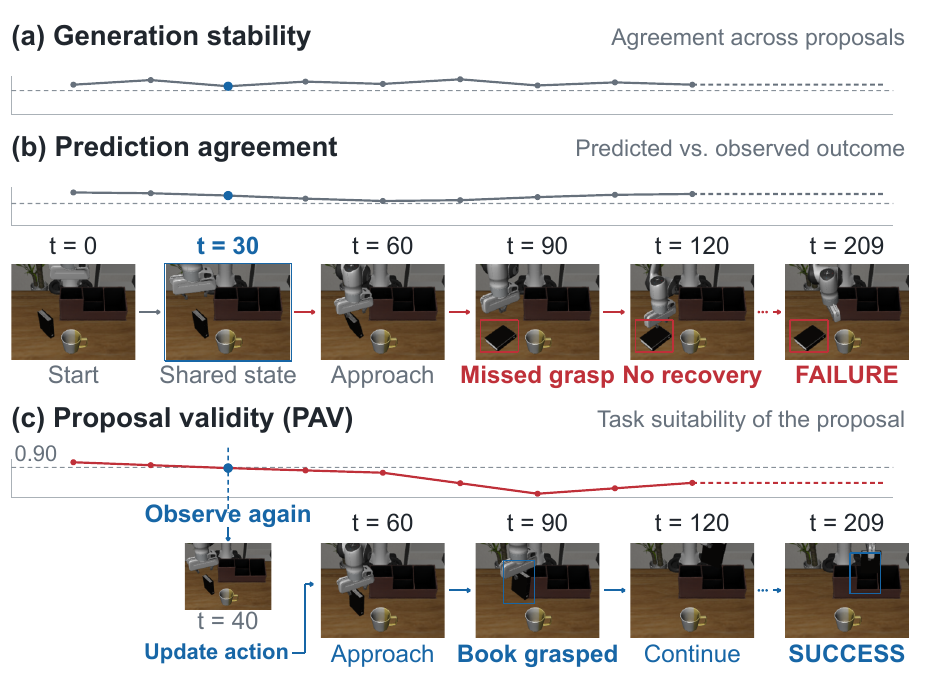
Vision-language-action (VLA) policies generate action sequences that reduce repeated inference, but deciding how much of each sequence to execute is critical to task success. Existing adaptive methods make this decision using generation stability or prediction agreement, yet these signals do not establish whether executing a candidate prefix preserves the ability to complete the task. We introduce a policy-aligned predictive verifier (PAV) that anticipates the consequences of candidate action prefixes and evaluates their compatibility with successful continuation before execution. Rather than using future prediction to generate actions, our method evaluates existing proposals in the VLA's internal task-conditioned representation space. To learn local judgments from terminal task outcomes, we combine trajectory-level survival supervision with a localization prior that preserves useful behavior within failed rollouts. The resulting validity scores guide execution-horizon selection. Evaluations with π0 and π0.5 across LIBERO, RoboTwin 2.0, and real-world manipulation show improved success–query trade-offs. These findings point toward a different role for future prediction in robotics, using it to assess how far to trust a policy's proposed actions rather than to generate new ones.
Key numbers
1. The problem: how long to trust an action chunk
VLA policies such as π0 output a chunk of H future actions per query. Executing the whole chunk saves inference but delays feedback, so systems usually execute only a prefix of length h and replan. Picking h well is the crux: too short wastes queries, too long lets errors accumulate.
Existing adaptive methods pick h from generation stability (do the actions regenerate consistently?) or prediction agreement (do predicted and observed dynamics match?). Neither establishes whether executing a prefix still leaves the task completable — a proposal can be consistently generated and accurately predicted, yet still miss the grasp.
2. Proposal validity, predicted and verified
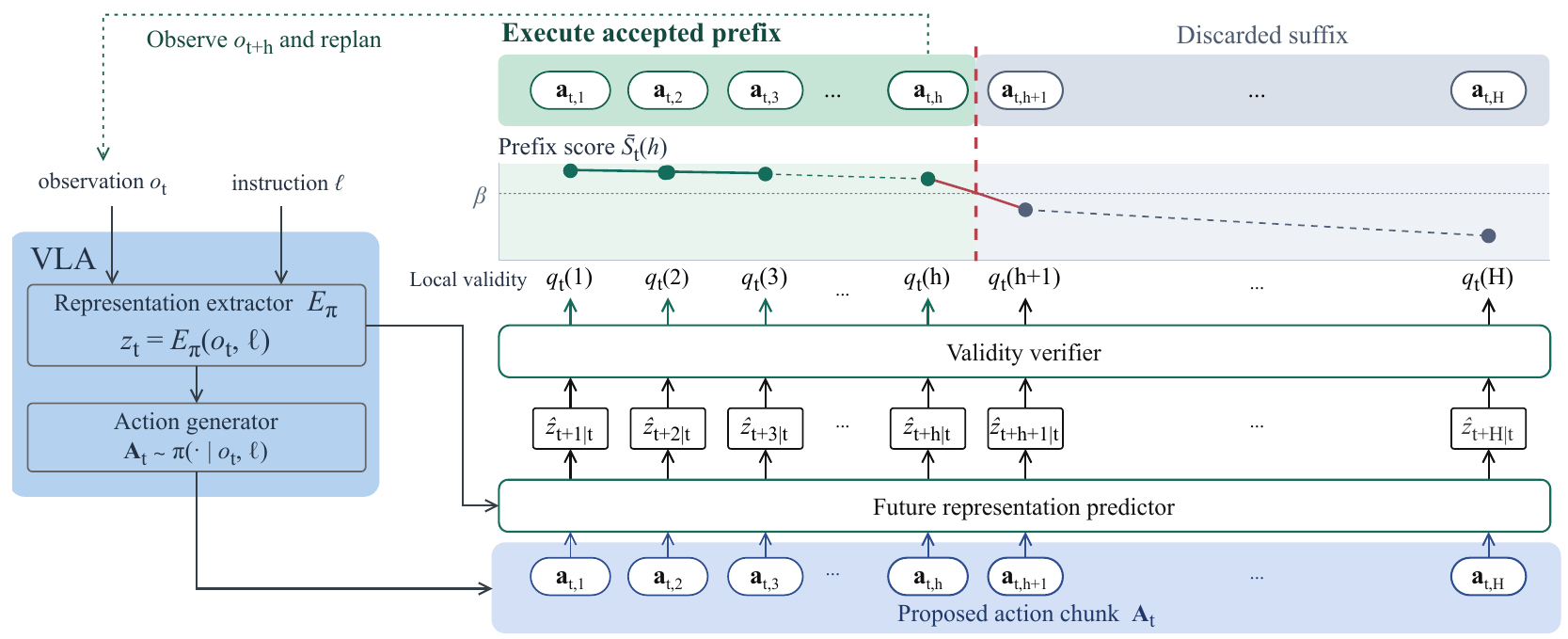
PAV targets proposal validity Vt(h): the probability that successful continuation remains possible throughout the first h actions. Because a compatible prefix has compatible predecessors, validity factorizes step by step, and each step splits into prediction and verification.
- Predict in policy space. A predictor maps the VLA's task-conditioned representation and an action prefix to the representation the policy would see after executing it, trained with a cosine alignment loss plus an action-swap margin so that predictions depend on the actions.
- Verify from task outcomes. A verifier scores local validity for each predicted step; the running product estimates Vt(h). Successful rollouts raise every factor, failed rollouts lower only the product, and a localization prior concentrates the blame on few steps so that valid behavior inside failed rollouts is not penalized.
- Select the horizon. At inference, candidate prefixes are checked in ascending order and execution stops at the first length-normalized score below a threshold.
3. Results
| LIBERO, π0.5 (H = 50) | Spatial | Object | Goal | Long | Avg. | Queries ↓ |
|---|---|---|---|---|---|---|
| h = 5 | 91.8 | 94.8 | 84.8 | 77.2 | 87.15 | 38.1 |
| h = 10 | 89.8 | 92.8 | 88.0 | 79.2 | 87.45 | 19.2 |
| h = 50 | 53.2 | 55.0 | 72.4 | 46.6 | 56.80 | 5.4 |
| AutoHorizon | 95.6 | 97.2 | 92.4 | 92.6 | 94.45 | 12.7 |
| PAV | 96.8 | 98.8 | 91.8 | 91.2 | 94.65 | 14.0 |
Success (%) over 50 trials per task and mean VLA queries per episode. The paper also reports π0 (H = 50) and π0.5 (H = 10), where PAV again has the highest average success (94.30% and 98.10%), plus A3, DVAC and VLA-Corrector references.
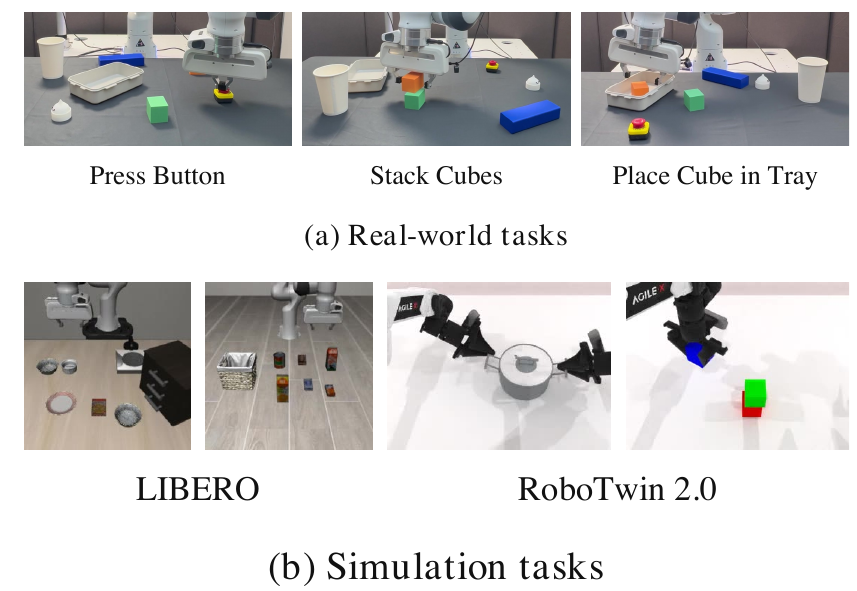
LIBERO. PAV has the highest average success in all three policy–chunk settings. The clearest gain is with π0.5 at H = 50: +7.50 pp over h = 5 with 63.3% fewer queries.
RoboTwin 2.0. With π0.5 (H = 32), PAV reaches 54.13% on DVAC's Selected 16 tasks, above the best fixed horizon (47.88%) and DVAC (41.6%), and 58.64% on all 50 tasks versus 55.76% for the best fixed horizon at similar query counts.
| Real world (π0.5) | Place Cube | Stack | Press | Avg. | Replans ↓ |
|---|---|---|---|---|---|
| h = 5 | 16.7 | 10.0 | 23.3 | 16.7 | 69.58 |
| h = 10 | 66.7 | 16.7 | 40.0 | 41.1 | 36.54 |
| h = 30 | 23.3 | 43.3 | 53.3 | 40.0 | 11.97 |
| h = 50 | 26.7 | 33.3 | 50.0 | 36.7 | 6.91 |
| PAV | 80.0 | 66.7 | 76.7 | 74.4 | 12.87 |
Success (%) over 30 trials per task on a 7-DoF Franka Panda, with mean replanning counts per episode.
Real world. PAV is best on all three tasks, averaging 74.4% versus 41.1% for the strongest fixed horizon. At a replanning count similar to h = 30 (12.87 vs. 11.97), varying the execution length lifts success from 40.0% to 74.4%.
4. What makes it work
| Variant (LIBERO, π0.5, H = 50) | Avg. success | Queries ↓ |
|---|---|---|
| Direct (no future prediction) | 84.55 | 22.3 |
| Prediction in DINOv2 space | 87.00 | 22.2 |
| PAV (prediction in policy space) | 94.65 | 14.0 |
Predicting the future matters. Scoring prefixes directly from current representations, with everything else fixed, loses 10.1 pp and needs more queries. The predictor is genuinely action-sensitive: on held-out rollouts its prediction reaches cosine 0.9401 to the observed future with the executed actions, versus 0.5304 with same-task swapped actions.
So does the space it predicts in. Predicting generic DINOv2 features instead of the VLA's task-conditioned representation drops success to 87.00%.
It is cheap. Verifier GPU compute takes 0.90–2.49 ms per query, or 0.45–1.24% of action-generation time across the four settings measured.
Takeaway
Effective action-chunk execution depends not only on generating coherent actions but on deciding how long to commit to them. PAV uses future prediction to assess how far to trust a policy's proposal — in the same representation space that generated it — rather than to generate new actions.
Citation
@article{kim2026pav,
  title   = {Policy-Aligned Predictive Verification for Adaptive VLA Action-Chunk Execution},
  author  = {Kim, Minkyu and Lee, Junhoo and Kim, Seungyeon and Jeon, Suhyun and Kim, Baekseung and Han, Donghoon and Kwak, Nojun},
  journal = {arXiv preprint arXiv:2610.21434},
  year    = {2026}
}