Abstract
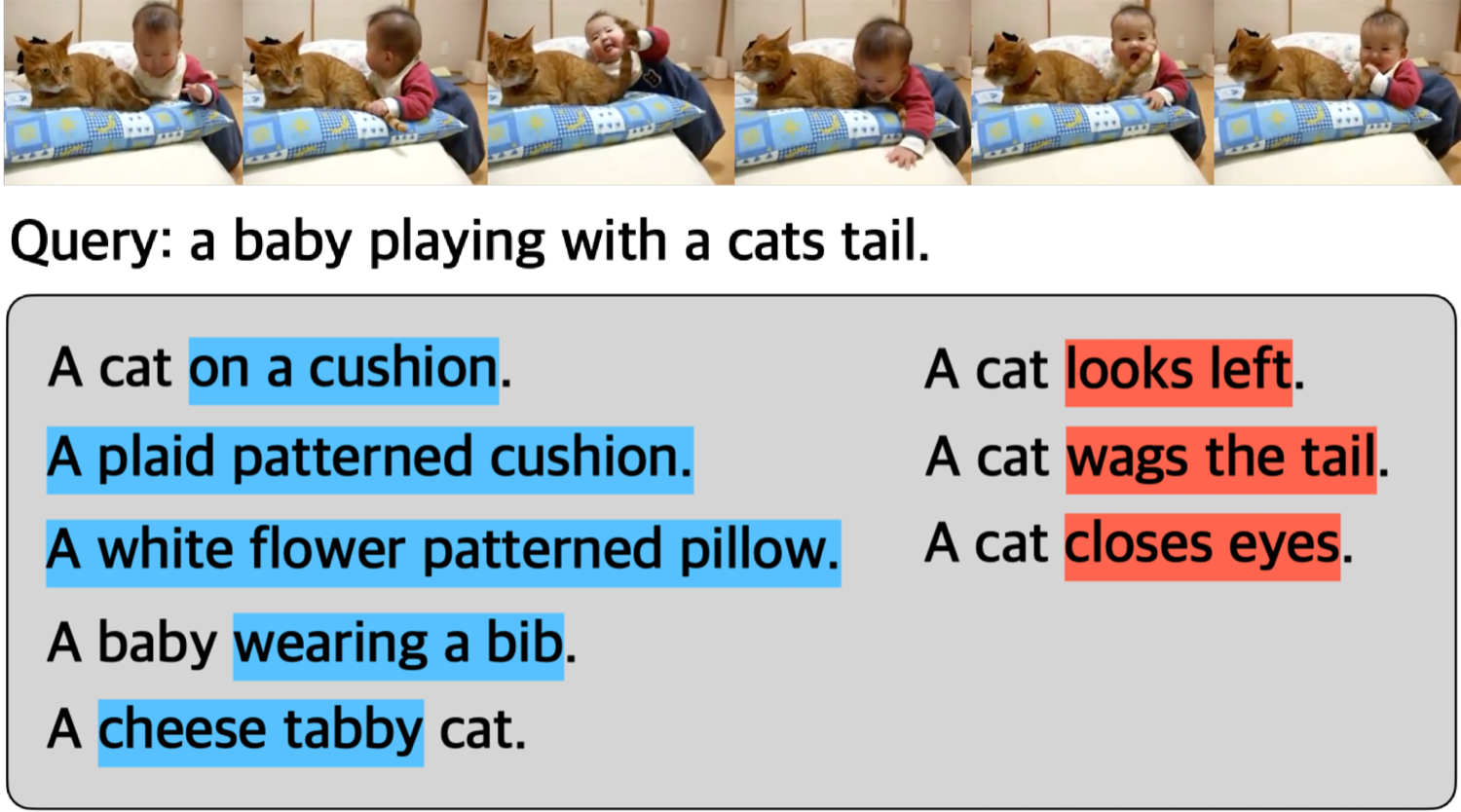
Users typically issue short, under-specified queries; videos contain rich multimodal context. This mismatch between query and content is a primary driver of retrieval errors, and one that prior work — focused on cross-modal interaction, foundation-model scaling, or probabilistic modeling — largely ignores. We introduce MERLIN (Multimodal Embedding Refinement via LLM-based Iterative Navigation): a training-free pipeline that uses an LLM and a multimodal LLM to simulate clarifying interactions, gradually refining the query embedding toward the user's intent. On MSR-VTT, MSVD, and ActivityNet, MERLIN delivers substantial gains in Recall@1 over strong retrieval baselines.
The query–video gap
Pipeline
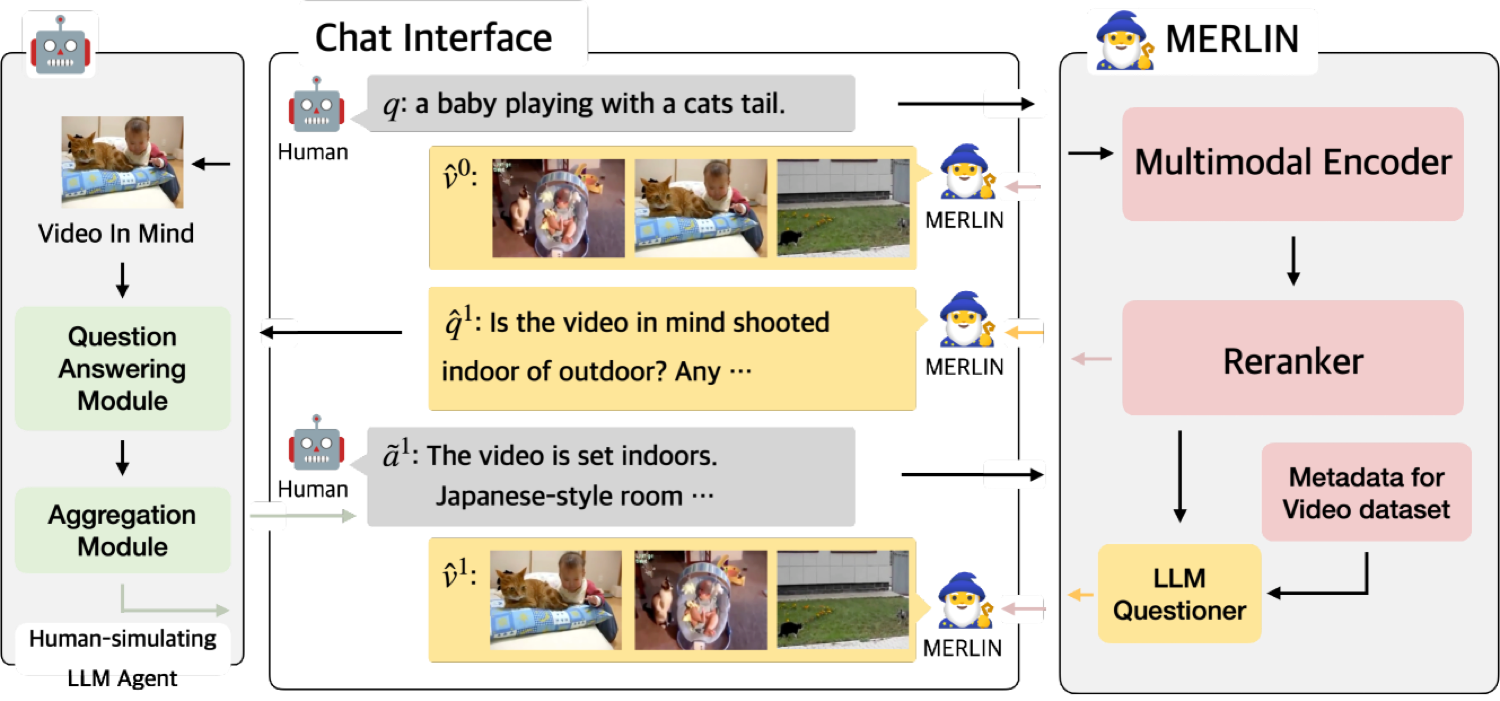
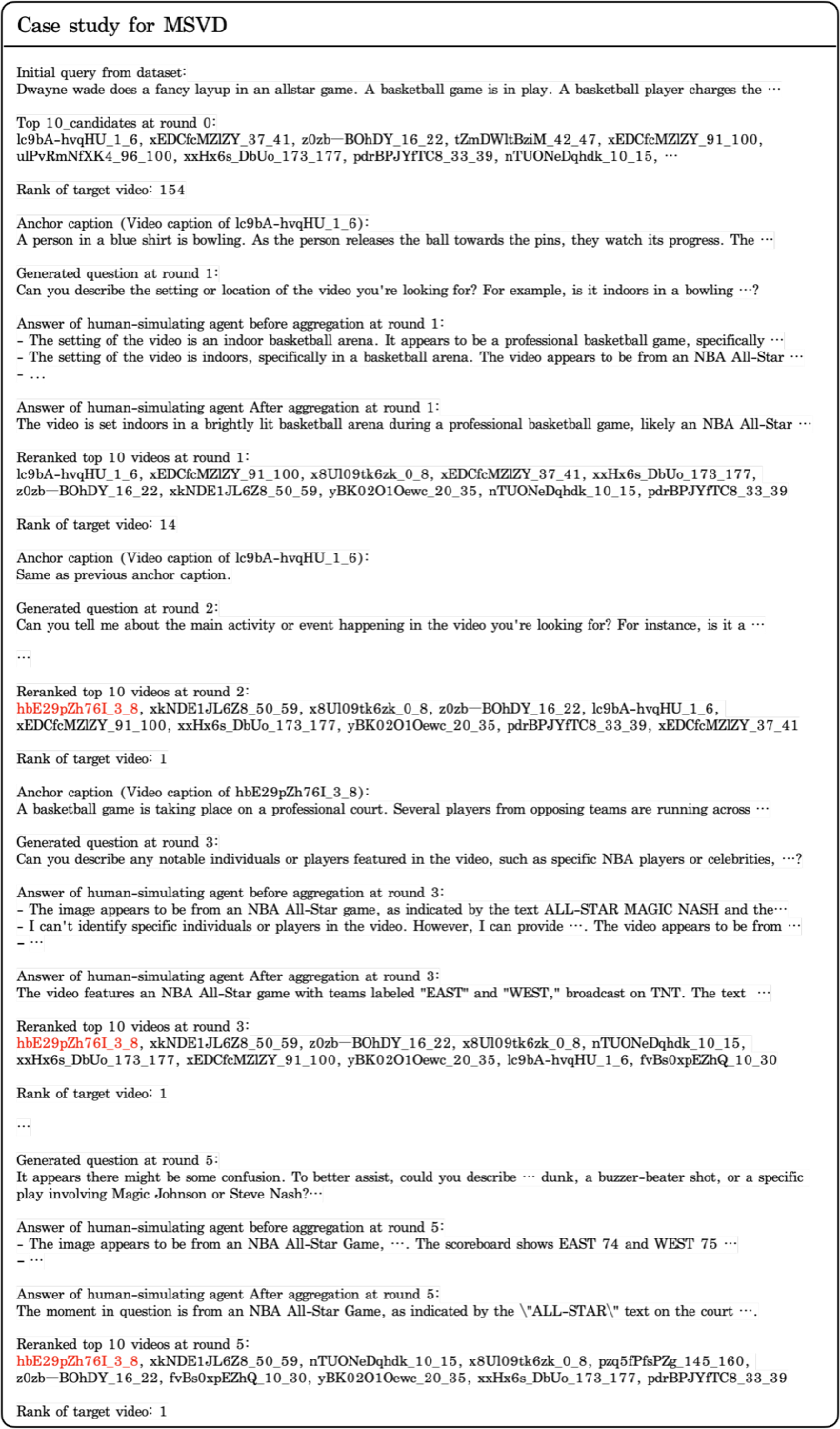
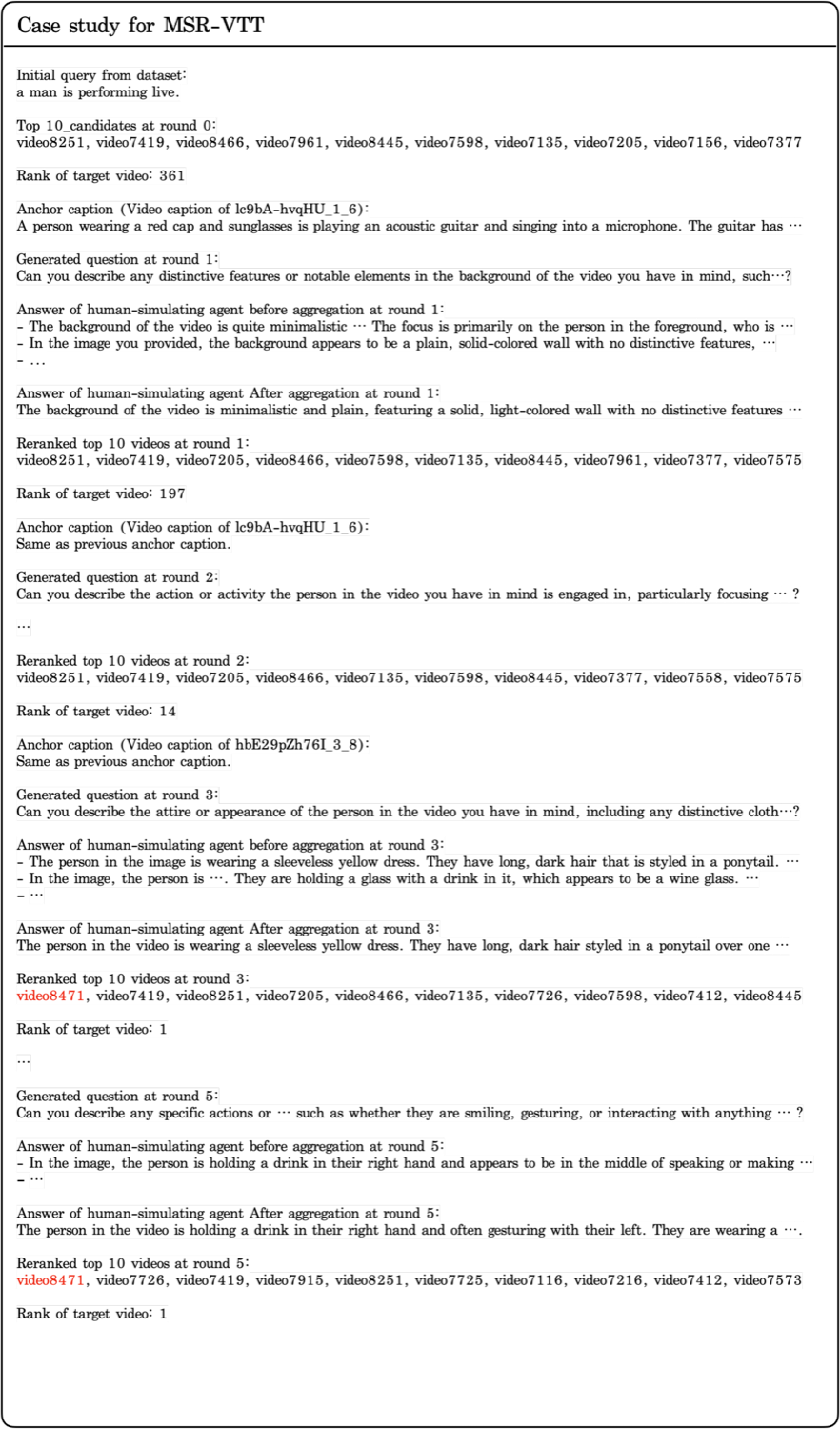
- Question generation. An LLM uses the top-ranked video's metadata to generate a clarifying question — eliciting context the user didn't initially provide.
- Human-simulating agent. A multimodal LLM answers the question by analyzing frames sampled at 1-second intervals; an aggregation step fuses frame-level answers into a video-level response.
- Iterative embedding refinement. The current answer embedding is combined with the running query embedding via SLERP (spherical linear interpolation) with α=0.8 — biasing toward earlier embeddings to prevent query drift.
Main results
Recall@1 / Recall@5 / Recall@10 from round 0 (baseline retriever) to round 5 (after five MERLIN iterations).
| Dataset | R@1 (R0 → R5) | R@5 (R0 → R5) | R@10 (R0 → R5) |
|---|---|---|---|
| MSR-VTT | 44.40 → 78.00 | 67.60 → 94.20 | 76.20 → 96.80 |
| MSVD | 52.39 → 77.61 | 77.16 → 94.48 | 84.78 → 97.31 |
| ActivityNet | 56.58 → 68.44 | 84.77 → 91.95 | 91.73 → 96.63 |
+76% relative R@1 on MSR-VTT, +48% on MSVD, +21% on ActivityNet — without training a new model.
Why iteration helps — and how it can hurt
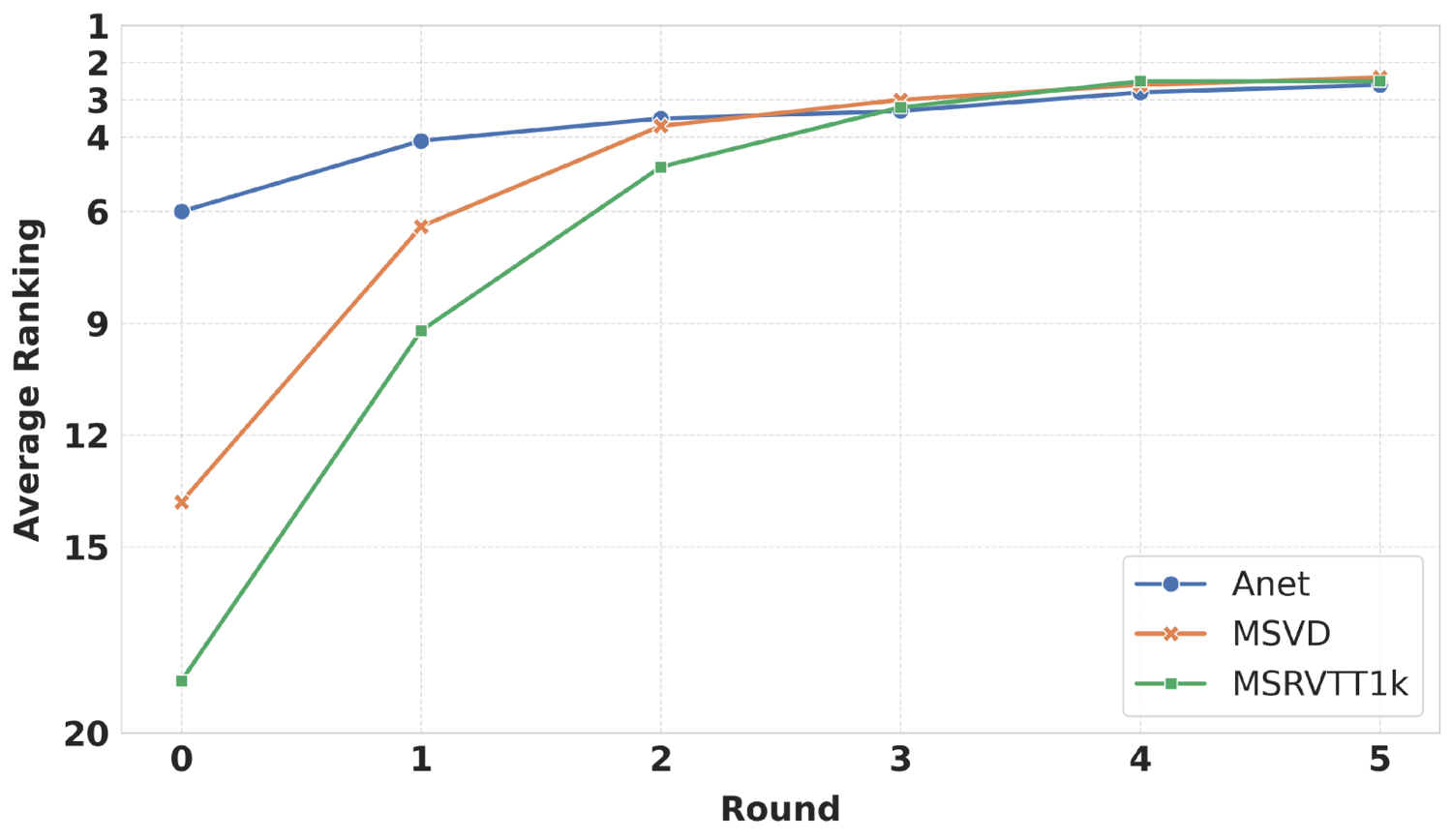
The fusion coefficient α controls how much weight the running embedding keeps versus the new round's answer. At α = 0.8, gains accumulate stably across rounds. At α = 0.2, the query is dragged by each new answer — initial rounds help, then performance declines as the embedding drifts away from the user's original intent.
Case studies
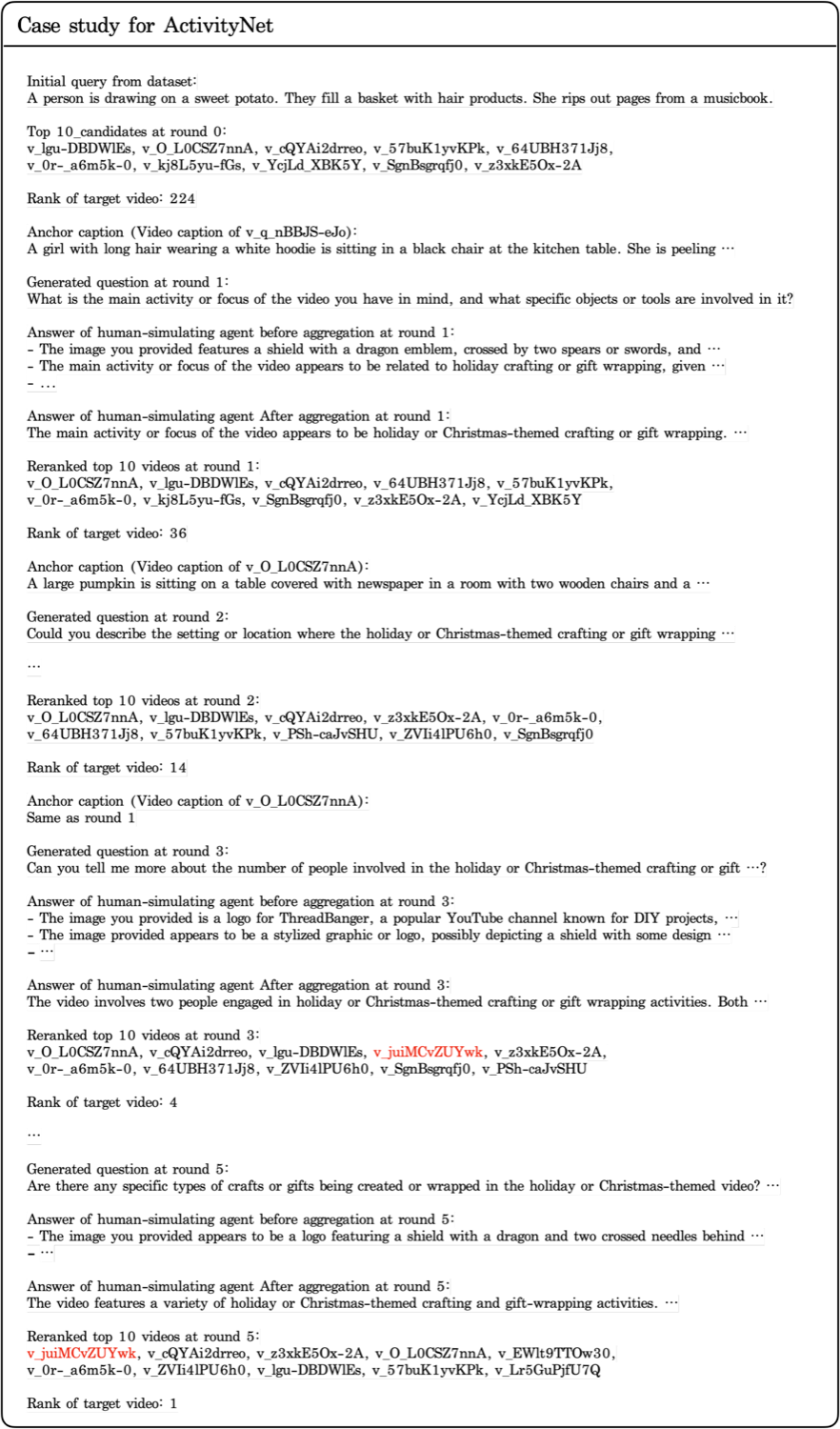
ActivityNet
MSVD
MSR-VTT
Citation
@inproceedings{han2024merlin,
  title     = {MERLIN: Multimodal Embedding Refinement via LLM-based Iterative Navigation for Text-Video Retrieval-Rerank Pipeline},
  author    = {Han, Donghoon and Park, Eunhwan and Lee, Gisang and Lee, Adam and Kwak, Nojun},
  booktitle = {EMNLP 2024 (Industry Track)},
  year      = {2024}
}